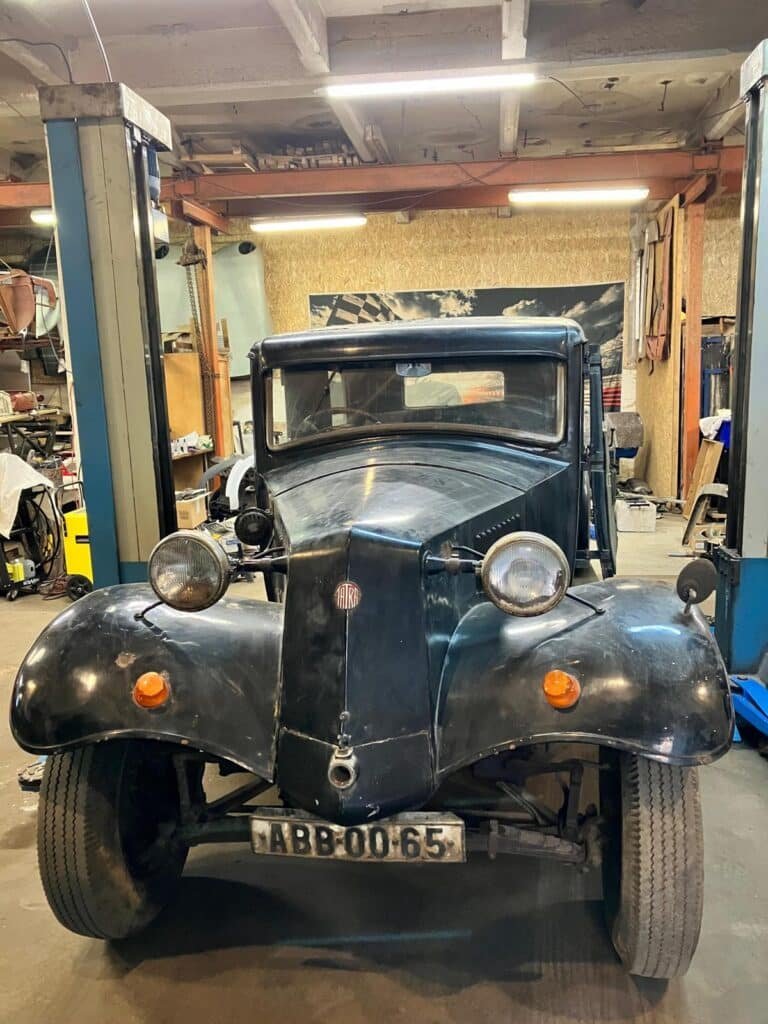
Suzuki LJ80 partial restoration including bodywork
This Suzuki LJ80 comes from the Lake Constance region of Germany and was entrusted to us for targeted partial restoration of the bodywork. The owner had already carried out some work on the vehicle himself in recent years. Our task is not a complete rebuild, but rather the expert refurbishment of the body structure at the crucial points.
After roughly 40 years of service, the LJ80's structural integrity is paramount. We're inspecting the sheet metal for corrosion, old repairs, and weakened areas. Spot repairs are being carried out where the bodywork is losing stability or where previous work isn't durable enough. A complete disassembly of the vehicle is not planned for this project.






Suzuki LJ80: Inspect the bodywork instead of completely disassembling it
This Suzuki LJ80 restoration deliberately focuses on a partial restoration. The aim is not to disassemble the car unnecessarily down to the last screw. It makes more sense to work selectively on the areas that are actually damaged and will be relevant for its future use.
Especially with the LJ80, it's crucial to distinguish between what is merely cosmetic rust, what is an old repair, and where the sheet metal is actually weakened. This distinction determines whether minor bodywork is sufficient or whether a larger area needs to be cut out.
Floor panels, wheel arches and door bottom edges on the LJ80
The Suzuki LJ80 has a bolted-on steel body on a ladder frame. In several user reviews of this model, rust, previous body filler work, and the replacement of damaged body panels repeatedly come up as issues. Therefore, we pay particular attention to the floor panels, wheel arches, door bottoms, sills, and the transitions to the underbody on this vehicle.
In our workshops, damaged areas aren't simply sanded down and patched. Corroded sections are exposed, assessed, and, if necessary, cut out. New sheet metal is fitted and cleanly welded in. The goal is a robust body repair, not a quick cosmetic fix.
Ladder frame, leaf springs and all-wheel drive technology according to findings
Technically, the Suzuki LJ80 is simple, but not undemanding. The ladder frame, rigid axles, leaf springs, selectable four-wheel drive, and transfer case must be compatible with the condition of the body. During a partial restoration, we inspect these components based on their condition, without artificially increasing the scope of work.
Particular attention should be paid to the frame, leaf spring mounts, axles, brakes, steering, and any visible leaks in the drivetrain. If play, rust, or previous work is detected, the scope of the restoration will be discussed with the owner. Technical restoration will only be carried out where necessary for safety, functionality, or durability.
What's important before a Suzuki LJ80 restoration
A Suzuki LJ80, SJ, or other classic Japanese off-road vehicle needs to be realistically assessed before any work begins. Not every instance of rust automatically means a complete restoration is necessary. Conversely, hidden damage to the floor, wheel arches, or mounting points can later cause significantly more work than is initially apparent.
If you're looking to restore a Suzuki LJ80 or a similar classic off-road vehicle, photos of the body, undercarriage, frame, wheel arches, doors, engine compartment, suspension, and brakes will be helpful. At our workshops in the Czech Republic, we'll assess whether bodywork, rust removal, mechanical restoration, painting, or a targeted partial restoration is the best option.