
An Audi Coupé with a long waiting time
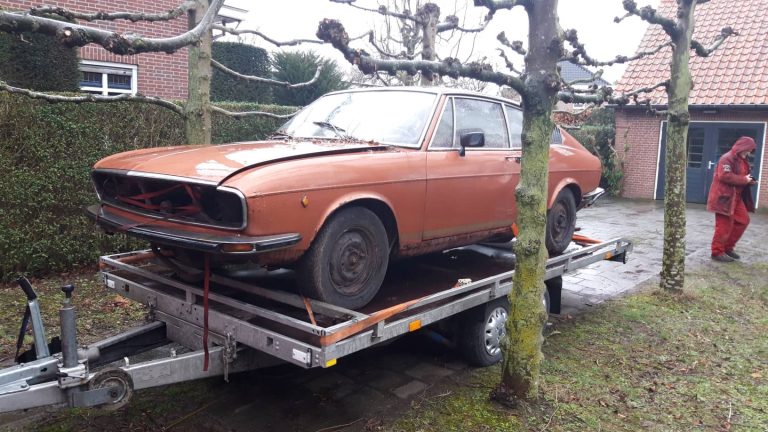
This 1972 Audi 100 Coupé S C1 was delivered to us from Belgium back in 2019. The car originally came from the Netherlands. Restoration was planned to begin in 2020. Then came COVID, and the owner's financial difficulties postponed the project indefinitely.
The Audi is still in storage with us. The complete restoration is now scheduled to begin in 2027. Therefore, this page is not a completed restoration report, but rather documentation of a future project. This is also part of the reality of classic car restorations: not every vehicle is immediately disassembled. Sometimes a car sits for several years.
Audi 100 Coupé S with 115 hp and manual transmission
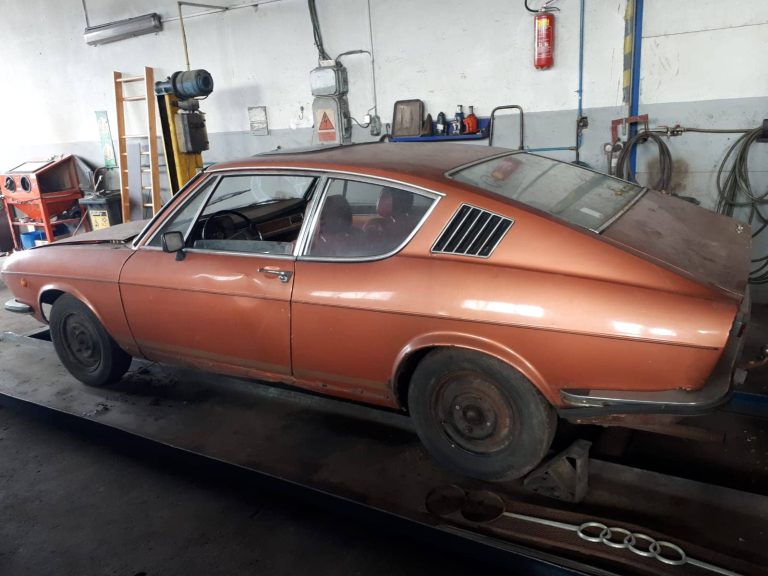
The Audi 100 Coupé S is one of the more interesting German coupés of the early 1970s. Developed on the basis of the Audi 100 C1, it appears significantly more distinctive than a simple two-door sedan. The long front, the low roofline, the large rear, and the front-wheel drive combine to create a car that straddles the line between the upper mid-range and the Gran Turismo concept.
This car is a 1972 Audi Coupé S with 115 hp and a manual transmission. The 1871 cc four-cylinder engine was sufficiently powerful for its time and suited the car's character: not a pure sports car, but a fast, elegant touring coupé. It is precisely this blend that makes the Audi 100 Coupé S so interesting today. It is rarer than many contemporary BMW, Mercedes, or Opel coupés, yet its technical history remains easily understood.
Typical Audi 100 Coupé rust spots
The car is complete, but shows the typical damage of this model series. When restoring an Audi 100 Coupé S, the sills, floor, wheel arches, doors, A-pillar areas, front grille, rear end, window frames, fender edges, and the leading edge of the hood must be carefully inspected. Especially with coupés that have been stored for a long time or have changed hands multiple times, rust often appears in places that are not immediately obvious.
The body of the Audi 100 C1 is not a simple parts donor. Panel gaps, large surfaces, chrome and trim strips, windows, and interior components must all fit together perfectly. Therefore, the real work doesn't begin with painting, but with disassembly, assessment, and deciding which areas can be replaced, repaired, or simply preserved.
Complete restoration starting in 2027
A complete restoration is planned. This includes the body, paint, engine, transmission, chassis, brakes, electrics, interior, chrome and aluminum parts, and final assembly. The original color will be restored. This makes sense for an Audi 100 Coupé S, as original color combinations and harmonious details contribute significantly to the overall appeal of these cars.
Parts availability for an Audi 100 Coupé S is not comparable to that of a Beetle, Mercedes, or early Porsche. Mechanical and wear parts are often manageable, but finding good body, trim, and interior parts requires patience. This is precisely why a complete vehicle is crucial as a starting point. Missing coupé-specific details can later cost more time than simply repairing visible rust.
Classic car restoration with realistic planning
This project also demonstrates that restoring a classic or vintage car involves more than just workshop work. Storage, budget, owner decisions, parts procurement, and external events like COVID can drastically alter the timeline. The Audi arrived in 2019, the planned 2020 start was postponed, and now 2027 is considered a realistic starting point.
For us, the car remains an interesting project, especially since the Audi 100 Coupé S isn't overrepresented in German-speaking countries. Many people are familiar with the sedan, but significantly fewer specifically search for the coupé. Anyone wanting to have an Audi 100 Coupé restored should therefore bring two things: patience and a complete car.
This C1 fulfills at least the second point. Now it's waiting for work to begin.